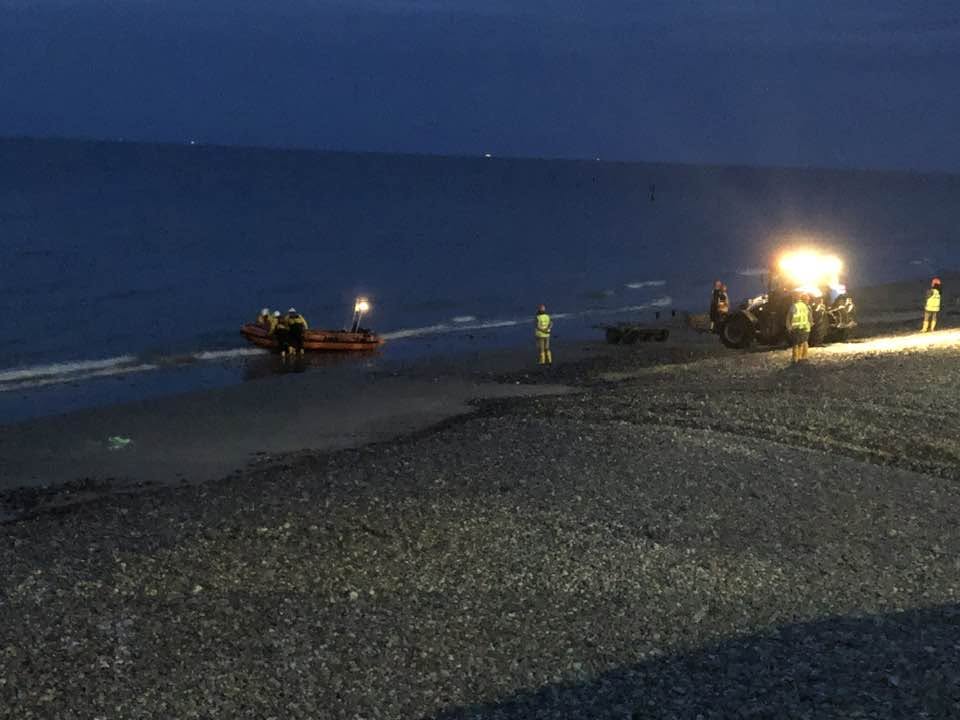
(Photo by kind permission of Lucy Edhouse Dallas: ‘Cromer RNLI crew out on exercise on a darkening August night’.)
*
‘Please can you leave the light on?
A predictable request from our little girl, and it’s understandable. Light is comforting, anchoring, and we are drawn to it. As the nights lengthen here in the UK and darkness settles into its allotted run – the 4pm need for headlights when it gathers speed, the waking to blackness outside, even to an absence of birdsong – its proximity needn’t dominate our lives.
Some of us need to deliberately keep chipper when summer fades. My sense of wellbeing is top-notch in summer; I feel well and happy when the sun is shining, at ease within myself, upbeat. In autumn, I can sink into gloom, with the grey months lined up and waiting. That’s why the title ‘Father of Lights’1 appeals to me at this time of year, and particularly into the dark hours ahead. It feels weird to admit to this right now, for our summer is still singing its heart out, though perhaps with terminal lucidity.
Thankfully, God has left the light on. He’s left all the lights on; creation is blazing with them!
Of course, the most obvious place to look is the night sky. When at its blackest, the stars burn brightest. Indeed, the stars are scientifically known to be clearer, to ‘appear sharper’ in winter. (AccuWeather). How can we not be in awe and wonder when staring into the night sky and feeling our own smallness in the light of its vastness? Scripture speaks of this being God’s handiwork: ‘Lift up your eyes and look to the heavens: Who created all these? He who brings out the starry host one by one and calls them each by name.’ (Isaiah 40:26). ‘The heavens proclaim the glory of God. The skies display his craftsmanship.’ (Psalm 19:1). And when it’s daytime and this spectacle is out of view, and the sun with it? It’s what we know about the sun that gives us perspective: blazing even when we cannot see it, capable of containing 1.3 million earths within it; that it shares its audible name with Jesus is no coincidence. While he is concealed from our sight for now, we know he is shining bright, and one day we’ll dwell with him, in that place where “the lamb is its lamp” and his “shining will never cease”. (Rev. 21:23).
There are other lights in creation too, and the original manuscripts leave the ‘lights’ open for us to interpret2: fireflies on a balmy summer’s night, then – unforgettable once witnessed, with their otherworldly brilliance, vivid in my mind after twenty-five years as I remember them lighting an evening walk in Nepal – and glowworms in cooler climbs, the ‘Bright scatter’d, twinkling star of spangled earth!’ for Wordsworth in his poem ‘To the Glow Worm’. Millipedes too glow at night as a warning not to consume them. My American friend tells me of luna moths, not a glow-in-the-dark creature but their wings flare with reflected moonlight. (They are beautiful and beg for a moment to be drawn.) There’s the snowdrops piercing the drab soil and lesser celandine later lighting up woodland floors… I know including flowers here is poetic licence, but they do contain ‘ultraviolet patterns and fluorescence that act as natural “landing lights” for insects’3. We only see such a fraction of the world’s glories.
David Atthowe explores this reality that much of nature is aglow with lights we cannot see: he uses UV torches to take photographs at night and takes people on nocturnal explorations. ‘His photos of temperate rain forest in Wales reveal shapes, structures and colours that rival a coral reef. “It is hidden from our human senses, waiting to be discovered,” he said.’ He speaks of ‘a “magic world” in which plants and animals fluoresce to communicate4.’
We will always take comfort in evidence of light. Descending on a city at the end of a flight, seeing the little lights of our home country beckoning, or approaching home on a dark night and seeing the lights shine from nearby residential roads, then from the windows of our own home. There is something mesmerising about lights and reassuring.
Lights more often than not mean safety. There is relief when we reach a section of path lit with streetlamps on a dark night, and as I write this I am looking at a picture of the Cromer RNLI lifeboat crew on a beach, preparing for an exercise. Amid the darkness, their boat and its launching rig are burning bright.
The safety and brilliance of God’s light is always available to us and light speaks of all that he is – In him ‘there is no darkness at all’. A pebble to roll over in the soul, for ‘The light shines in the darkness, and the darkness has not overcome it.5’
- James 1:17 ↩︎
- The word heavenly is added to some versions. ↩︎
- https://www.greatbritishlife.co.uk/magazines/norfolk/24047910.biofluorescence-nature-night-walks-light-norfolk/ ↩︎
- https://www.bbc.co.uk/news/uk-wales-68301119 ↩︎
- John 1:5
↩︎

